
By Ayo Ajayi, Editor, EDUTORIAL
Every time a family member visits a hospital, clinic, pharmacy or other healthcare facility, there is an expectation that the care received will be safe. Yet patient safety is not simply about receiving the right diagnosis or treatment. It also involves preventing avoidable harm throughout the patient's journey through the healthcare system.
As the world marks World Patient Safety Day on September 17, 2026, the World Health Organization (WHO) is drawing attention to the safety of people living with noncommunicable diseases (NCDs), under the theme “Safe care for noncommunicable diseases” and the slogan “Safe care for life!” WHO notes that people living with conditions such as cardiovascular diseases, cancer, diabetes and chronic respiratory diseases often require long-term and repeated interaction with health services, creating multiple points at which safety risks can arise.
WHO estimates that about one in every 10 patients is harmed during healthcare globally, with around half of such harm considered preventable. Common sources of harm include medication errors, diagnostic errors, healthcare-associated infections, unsafe surgical procedures, patient misidentification and communication failures.
But what does patient safety mean for an ordinary Nigerian family? More importantly, what can patients and caregivers actually do to make healthcare safer?
1. What exactly is patient safety?
Patient safety is essentially about preventing avoidable harm and reducing unnecessary risks associated with healthcare.
It covers virtually every stage of care — from correct identification of the patient and accurate diagnosis to appropriate medication, safe procedures, infection prevention, communication, follow-up and continuity of care.
WHO emphasises that patient safety is not simply a matter of individual healthcare workers avoiding mistakes. Healthcare is a complex system, and failures in processes, communication, teamwork, staffing, technology and coordination can contribute to patient harm.
This means that hospitals and healthcare professionals have major responsibilities, but patients and families also have an important role in making care safer.
2. What are the common patient-safety risks families should know?
Families should be particularly conscious of medication errors, diagnostic errors, healthcare-associated infections, patient misidentification, unsafe procedures, communication failures and problems during referrals, transfers or discharge.
For patients living with chronic conditions, the risks may be more complex because they may require several medicines, repeated investigations and consultations with different healthcare professionals over a long period.
WHO's 2026 campaign specifically highlights the risks associated with fragmented care, medication-related harm, diagnostic problems and poor communication across the continuum of care.
3. How can families help ensure that medicines are used safely?
Patients and caregivers should know the names of the medicines being taken, what each medicine is intended to treat, the prescribed dose, how frequently it should be taken and any important precautions.
It is equally important to tell healthcare professionals about allergies and previous reactions to medicines, as well as all other medicines being taken.
Families should not assume that only prescription medicines matter. Over-the-counter medicines, supplements and herbal or traditional preparations may also affect treatment or interact with prescribed medicines.
Patients should also avoid changing doses, stopping prescribed medication or combining medicines without appropriate professional advice.
4. Why should doctors know about traditional remedies, supplements and other medicines?
Complete information about a patient's medication use helps healthcare professionals identify possible interactions, duplication of treatment and other potential risks.
A patient who is already taking prescribed medicine should therefore inform the healthcare professional about vitamins, supplements, herbal preparations and other remedies being used.
This becomes particularly important when a patient changes doctors, is admitted to hospital, is referred to another facility or is receiving treatment for more than one condition.
Good communication about medicines can help healthcare professionals make safer decisions.
5. What should a patient ask before undergoing a procedure or treatment?
Patients and caregivers should understand what condition is being treated, what the proposed treatment involves, why it has been recommended, its expected benefits and its significant risks.
They should also ask whether there are reasonable alternatives and what may happen if treatment is delayed or not undertaken.
For a surgical procedure or other major intervention, patients should understand the preparation required, what recovery may involve and which symptoms after the procedure should prompt urgent medical attention.
Asking questions is not a sign of distrust. It is an important part of informed participation in healthcare.
6. What should a family do when something appears wrong?
The first step is to raise the concern promptly with the healthcare professional responsible for the patient's care.
For example, if a medicine appears different from what was previously prescribed, if an instruction is unclear or if a patient's condition changes unexpectedly, the family should seek clarification rather than remain silent.
If the concern is not adequately addressed, it may be appropriate to speak with a senior clinician, nursing supervisor, hospital management or the relevant patient-relations channel available at the facility.
Patients and caregivers should be encouraged to speak up respectfully. WHO identifies patient and family engagement as an important component of safer healthcare.
7. How can families prevent communication problems?
Families can help by providing healthcare professionals with accurate information about the patient's medical history, allergies, previous diagnoses, medicines and significant treatments.
It is useful for a family to keep important medical records, prescriptions, laboratory results and discharge documents together, particularly when a patient receives care from different facilities.
When instructions are complex, caregivers can write them down or repeat them back to the healthcare professional to confirm that they have understood them correctly.
This becomes particularly important when a patient is seriously ill or unable to communicate independently.
8. Why is correct patient identification so important?
Before medicines are administered, blood is transfused, specimens are collected or procedures are performed, healthcare professionals must ensure that they are dealing with the correct patient.
A failure to correctly identify a patient can contribute to serious medical errors. WHO lists patient misidentification among recognised sources of avoidable harm in healthcare.
Patients and families can assist by ensuring that the patient's name and other identifying details are correctly recorded and by pointing out any discrepancy they notice.
Even when a healthcare professional appears familiar with the patient, confirming identity remains an important safety practice.
9. What patient-safety issues should Nigerian families pay particular attention to?
Families should pay close attention to communication, medication safety, documentation, infection prevention, continuity of care and understanding of treatment instructions.
Where possible, patients should keep copies of prescriptions, investigation results and important medical reports. They should also provide healthcare professionals with an accurate history of previous illnesses, allergies and medicines.
At the same time, patient safety should not become a confrontation between families and healthcare workers.
The objective is collaborative care. Patients should ask questions respectfully, healthcare professionals should provide appropriate explanations, and both sides should communicate when something is unclear or potentially unsafe.
WHO's patient-safety framework recognises that harm can result from several interacting factors, including system and organisational problems, communication breakdowns, inadequate processes and patient-related factors.
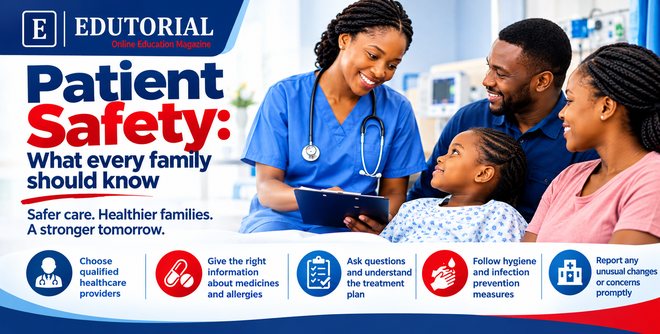
10. Five simple rules every family should remember
For families looking for a simple starting point, five principles stand out:
Know the patient. Make sure the patient's identity and relevant medical information are correctly recorded.
Know the medicine. Understand what each medicine is for, the prescribed dose and how it should be taken.
Ask questions. Make sure you understand the diagnosis, investigation, treatment or procedure being proposed.
Speak up. If something appears different from what was explained or something does not seem right, raise the concern promptly.
Keep records. Preserve important prescriptions, investigation results, treatment summaries and discharge documents.
These may appear to be simple steps, but they can make communication between families and healthcare professionals clearer and help patients become more actively involved in their own care.
Patient safety is everyone's concern
Patient safety is ultimately about more than avoiding mistakes. It is about creating a healthcare environment in which patients receive appropriate, respectful and coordinated care and where potential problems are identified and addressed as early as possible.
This is particularly important for people living with noncommunicable diseases, whose healthcare journey may continue for years and involve multiple medicines, investigations, healthcare professionals and facilities.
For World Patient Safety Day 2026, WHO is calling for people living with NCDs and their caregivers to become partners in safe care — asking questions, understanding their medicines and treatment, maintaining health information, recognising warning signs and communicating when something does not seem right.
Safe healthcare is not achieved by healthcare professionals alone. An informed, attentive and engaged patient and family can also become an important part of the safety system.
---
Editorial Note: This EDUTORIAL feature is an educational explainer based on patient-safety guidance and information published by the World Health Organization (WHO). It is intended for general public education and should NOT be regarded as a substitute for personalised medical advice from a qualified healthcare professional.
