
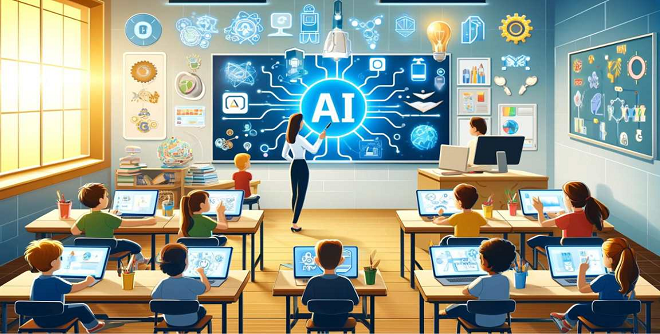
By Ayo Ajayi | EDUTORIAL
Across Nigeria, the classroom is changing.
The chalkboard and marker are increasingly sharing space with smartphones, computers, digital learning platforms and a new technology that is forcing educators around the world to reconsider what it means to teach: artificial intelligence.
For a Nigerian teacher, the arrival of AI presents both an opportunity and a challenge.
A teacher can now use AI to generate lesson ideas, simplify difficult concepts, develop classroom activities, create assessment questions, conduct research and produce learning materials within minutes. Students, too, can access tools capable of answering questions, explaining concepts and generating written work almost instantly.
But beneath this remarkable convenience lies a difficult question:
What happens to the role of the teacher when technology becomes increasingly capable of delivering information?
As Nigeria joins the world to mark World Teachers’ Day on October 5, the conversation about teachers and artificial intelligence is particularly important. The question is no longer whether AI will enter the classroom. It already has.
The more urgent question is whether Nigerian teachers and education systems are prepared to use it intelligently, ethically and responsibly.
Artificial intelligence is already changing the teacher's role. But rather than eliminating the need for teachers, it has the potential to shift the emphasis from simply transmitting information to helping learners understand, question, evaluate and apply knowledge.
This means that teachers must understand what AI can do, what it cannot do and, perhaps most importantly, what it should never be allowed to do.
A teacher who understands AI can use it as an assistant rather than regard it as a competitor. It can help with lesson planning, brainstorming, research, preparation of quizzes and other assessment materials, differentiation of learning content and the development of classroom resources. It can also help teachers save time on some routine tasks, allowing more attention to be devoted to learners.
But efficiency must not be confused with effectiveness.
The fact that AI can generate a lesson plan does not mean that the lesson is appropriate for a particular class. The fact that it can produce an answer does not mean that the answer is accurate. And the fact that it can generate an assessment does not mean that the questions properly measure what students are expected to learn.
This is where professional judgement becomes even more important.
Teachers must remain the decision-makers in the classroom. AI-generated information should be checked, adapted and evaluated rather than accepted simply because it appears sophisticated or authoritative. The teacher's knowledge, experience and understanding of individual learners remain indispensable.
There are also dimensions of teaching that technology cannot adequately reproduce.
A teacher notices when a normally active student becomes unusually quiet. A teacher can recognise fear, confusion, discouragement or a lack of confidence in a child's behaviour. A teacher can encourage a struggling learner, challenge a gifted one and provide the human connection that can transform a student's attitude towards education.
AI can provide information.
The teacher provides relationship, context, judgement and human connection.
That distinction is critical.
The growing availability of AI also creates the danger of overdependence. If teachers begin allowing technology to do their thinking, planning and professional decision-making for them, the very skills that make them effective educators could gradually weaken.
Teachers therefore need to develop what might be called AI literacy — not merely knowing how to operate AI tools, but understanding their limitations, questioning their outputs, protecting sensitive information and deciding when AI should and should not be used.
This places a major responsibility on governments, school owners and education authorities.
It is not enough to tell Nigerian teachers to embrace artificial intelligence. They must be trained and supported to use it. Professional development programmes should include practical AI competencies, ethical considerations, digital safety, information verification and classroom applications.
UNESCO's work on AI and education similarly emphasises the importance of building teachers' competencies while protecting teacher agency and ensuring that technology supports, rather than undermines, the human dimension of education.
The challenge extends beyond teachers.
Students must also be taught how to use AI responsibly.
There is a significant difference between using AI to understand a difficult concept and asking it to complete an assignment that a student is expected to do independently. There is a difference between using AI to generate ideas and presenting AI-generated work as one's own.
Without appropriate guidance, AI could encourage laziness, plagiarism, academic dishonesty and an unhealthy dependence on technology.
Teachers therefore have an important new responsibility: to teach students not only how to use AI, but how to think critically about AI.
Schools may need to rethink some traditional approaches to assessment. If students can easily generate essays and answers using AI, educators will increasingly need assessment methods that test understanding, reasoning, creativity, oral communication, practical application and the ability to defend one's ideas.
But there is another Nigerian reality that cannot be ignored: access.
While some schools are experimenting with sophisticated digital technologies, others continue to struggle with basic electricity, internet connectivity, computers and reliable access to learning resources.
This creates a serious risk.
If AI becomes an important part of education but access remains concentrated among better-resourced schools and communities, technology could widen rather than reduce Nigeria's educational inequality.
The solution must therefore be inclusive.
Government and education stakeholders need to address the underlying digital infrastructure gap while developing AI-related educational policies. Investment in electricity, connectivity, affordable devices, teacher training and locally relevant digital resources will be essential if AI is to benefit Nigerian learners broadly rather than become another marker of inequality.
There is also an ethical dimension that cannot be ignored.
Teachers using AI must be conscious of issues surrounding accuracy, bias, privacy and the protection of students' personal information. AI systems can produce convincing but incorrect information, reproduce biases contained in their training data and create privacy concerns when sensitive information is entered into digital platforms.
Consequently, AI literacy must include ethical literacy.
Teachers need to know not only what AI can do, but also where the boundaries should be drawn.
The future, therefore, should not be imagined as a contest between teachers and machines.
The more productive vision is a partnership in which technology handles some routine and supportive functions while teachers retain responsibility for professional judgement, relationships, mentorship, creativity and the development of the whole learner.
The ideal Nigerian classroom of the future should not be one in which artificial intelligence replaces the teacher.
It should be one in which a well-trained teacher knows when to use AI, how to use it and when not to use it.
That requires a new generation of teachers who are technologically confident but not technologically dependent; innovative but still grounded in sound pedagogy; open to AI but capable of questioning its outputs.
For Nigeria, the task is therefore not simply to introduce artificial intelligence into schools.
The greater task is to prepare teachers who can lead students through an AI-driven world without surrendering the human purpose of education.
As World Teachers' Day provides an opportunity to reflect on the future of the teaching profession, one lesson is becoming increasingly clear: technology may change the tools of education, but it should not change the fundamental reason we educate.
And perhaps that is the most important question for the future of teaching:
If AI becomes increasingly capable of delivering information, what will make the human teacher more valuable—not less—in the education of the next generation?
The answer may lie in everything AI cannot be: a mentor, a role model, a listener, a motivator, a trusted adult and a human being who sees not merely a student's answer, but the student behind it.
That is where the enduring value of the teacher will remain.
