
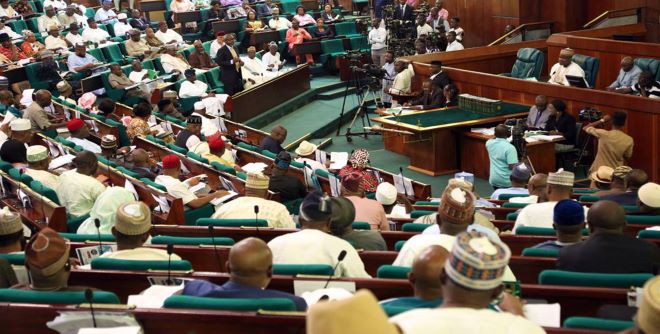
The House of Representatives will host an education summit in November to address the challenges in the tertiary education sector.
Speaker Femi Gbajabiamila disclosed this on Monday during a meeting between the leadership of the House, the Academic Staff Union of Universities (ASUU), and the representatives of the federal government on the implementation of the agreement on the recently suspended strike.
The ASUU delegation was led by its President, Emmanuel Osodeke, while the federal government delegation was led by the Acting Accountant General of the Federation, Okolieaboh Sylva.
The speaker said the summit will address the challenges confronting the sector and proffer lasting solutions that will end the perennial industrial action by the lecturers.
“This ASUU strike is becoming perennial, our education is in disarray and the House is organising a summit on the education sector. The notice will be out. All these issues are to be addressed. The summit will be starting in November,” he said while reacting to concerns of ASUU to end the perennial strike.
Mr Osodeke said the strike was called off without an agreement but that the union acted on trust.
He stated that the agreement on incorporating the University Transparency and Accountability Solution (UTAS) into the Integrated Payroll and Personnel Information System (IPPIS) to address the peculiarity of the university system is a temporary arrangement, hence, there is a need for a final agreement.
“The strike we called off, our members did it based on trust in us and the way the speaker has intervened—three meetings now. It was on that basis we were able to convince them.
“What we agreed on the issue of IPPIS and UTAS is a temporary measure,” he said.
Mr Osodeko also spoke on the inability of universities to generate money through investment. He said the Tertiary Single Account (TSA) is preventing universities from investing their funds.
He stated that the University of Lagos used to invest its funds in the past but that TSA has ended it.
“The greatest problem universities have is this TSA. In those days, Unilag had one of the best investments in the world. They invest money and make profits. But today, no university can invest money because of the TSA. Thus distorting the revenue of most agencies.
“These things that these foreigners tell us to do, they don’t do in their countries. Because of the peculiarity of universities, we agreed that let some of these universities take care of their funds and use it for investments and make a profit. You have universities that have N10 billion in their accounts and are not yielding profit because of TSA,” he said.
Reacting to the concern, Mr Gbajabiamila said there is an agreement to amend the National Universities Commission (NUC) to allow universities to invest their money.
In his remarks, Mr Sylva said the government will compile a list of peculiarities of the university system and adjust the platform accordingly.
“I think it is high time we met to have a comprehensive list of all the peculiarities of ASUU and their members. Whatever the number, whatever the complication may be, we should be able to clear this
“We have to continue to pay ASUU and their members. What we will do is look at what we have at the moment so that we can continue to pay them. We are accommodating all the material peculiarities. I am a new face in this negotiation,” he said.
Following the comments, they went into an executive session to address some of the issues.
Premium Times
