
Nearly a decade after a young NYSC corps member first began handing out clothes and snacks to street children in Plateau State, the organization she went on to build has awarded 104 scholarships out of 206 applications received, a milestone the foundation says reflects years of trial, error, and steady institution-building rather than a single turning point.
Shela Quest Foundation (SQF), a Nigerian NGO focused on educational access for marginalized children, released the figures this week as part of an ongoing effort to document its history and current reach.
How It Started
The foundation traces its origins to 2017, when founder Omotola Oladapo was posted to Jos, Plateau State for her National Youth Service Corps (NYSC) year, her first time leaving Nigeria's southwest region. She was met with a scale of visible child poverty she hadn't encountered before: children as young as two and as old as eighteen begging on the streets. Asking questions about who they were led her to the Almajiri system, an informal Quranic education structure under which an estimated 17 million children were living outside the formal school system as of 2017, according to figures the foundation cites from that period.
A single moment crystallized the decision to act: seeing a young boy, no older than four or five, eating rotten watermelon off the floor of a local market. Omotola, who did not have the means to address the scale of the problem alone, began organizing anyway. Because cultural norms in the region meant she could not approach local religious leaders (mallams) directly as a woman, her supervisor at the Nigeria Civil Defence Corps stepped in as an intermediary, a partnership the foundation credits as instrumental to its earliest work.
What began as a one-day "Children's Day" event, corps members donating clothes, shoes, and money for snacks, evolved into an organized group focused on sustained fundraising and training, rather than one-off relief.
Early Setbacks and a Pivot That Stuck
In 2018, the group took its first structured step outside Plateau State, traveling to Kano, Nigeria's city with the highest concentration of out-of-school children, to pilot a train-the-trainer program in partnership with the National Agency for the Prohibition of Trafficking in Persons (NAPTIP). The original plan involved teaching local trainers Ankara craft-making, paint-making, and adire (tie-dye) production, skills intended to be passed on after the group's departure. That model did not work, and the program was scrapped.
Rather than step back, the group reassessed and identified shoemaking as a more viable trade; the materials were inexpensive and widely available, removing a key barrier to sustainability. Partnering with a professional shoemaker, the group trained 16 boys, providing meal stipends to help them stay enrolled. Six completed the program and received tools to start their own shoemaking businesses. The foundation has acknowledged it lost contact with the group after training ended and did not track their subsequent outcomes, a gap that later informed its push toward more structured, trackable programming.
Formalizing the Mission
As Nigeria's economic conditions shifted in subsequent years, sustained travel to the North became harder to justify, and the organization redirected its focus toward the broader, nationwide problem of unaffordable school and exam fees, a challenge it found was not confined to the North but present across the country.
The organization's name evolved alongside its mission: what started as ProjectEAT (Educate/Empower an Almajiri Today) got formally registered with Nigeria's Corporate Affairs Commission (CAC) in 2024 under its current name, Shela Quest Foundation. That registration marked a turning point, giving the organization the legal and operational structure to launch its scholarship program and other formal initiatives.
The Numbers Today
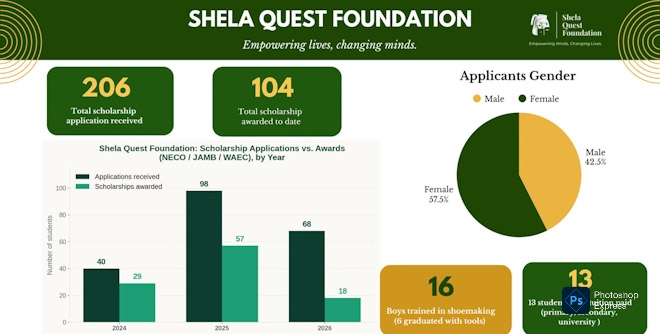
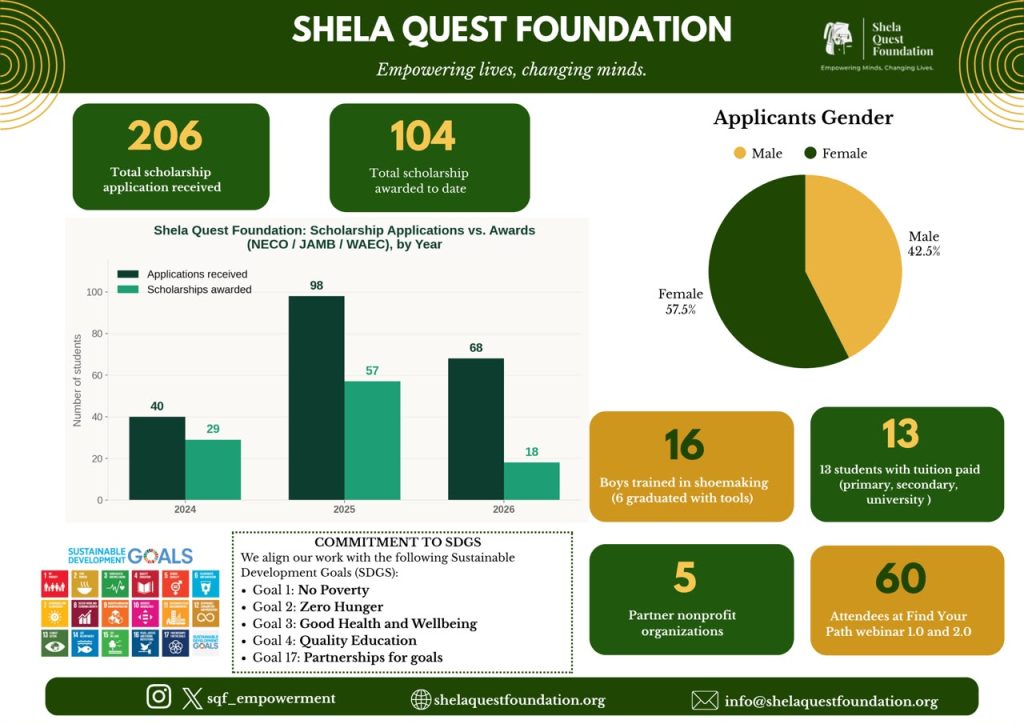
Since the scholarship program's launch, SQF has received 206 applications and awarded 104 scholarships across three national examination tracks — NECO, JAMB, and WAEC. The year-by year breakdown shows uneven but instructive growth:
2024: 40 applications received, 29 scholarships awarded
2025: 98 applications received, 57 scholarships awarded — the foundation's largest cohort to date
2026: 68 applications received, 18 scholarships awarded
One trend the foundation is highlighting: 57.5% of applicants across its scholarship cycles have been female, with the share of female applicants rising from 54.4% in 2025 to 61.2% in 2026. The foundation points to this as evidence that its outreach is increasingly reaching girls in communities where access to education has historically lagged furthest behind.
Beyond the Classroom
The scholarship program sits alongside a broader set of initiatives the foundation has built over the years:
16 boys trained in shoemaking, with 6 graduating and receiving tools to start their own businesses
13 students with tuition fully sponsored across primary, secondary, and university levels
60 attendees across two iterations of the foundation's "Find Your Path" career and mentorship webinar
5 partner organizations now working alongside SQF on shared programming
A "Child2Sponsor" initiative connecting individual donors directly with academically talented girls, including one student currently enrolled in a private university under an ongoing sponsorship.
Looking Ahead
"We're just getting started," Omotola said in a statement announcing the figures.
With its scholarship infrastructure now formalized, the foundation says its next phase will focus on expanding into skill acquisition and entrepreneurship programming, giving students access to life skills that can translate into financial independence alongside their formal education. SQF also plans to grow its network of nonprofit partners who share its goals and mission, with the aim of extending its reach to more students. Looking further out, the foundation says that within the next five years, it hopes to be reaching students not only across Nigeria but in other parts of Africa as well.
---
For partnership, sponsorship, or volunteer inquiries, contact Shela Quest Foundation at info@shelaquestfoundation.org or visit shelaquestfoundation.org.
