
By Ayo Ajayi
Gender equality must be treated as a fundamental development issue rather than a side concern if the world is to achieve inclusive and equitable development and make meaningful progress towards the Sustainable Development Goals (SDGs), Professor Tayo George has said.
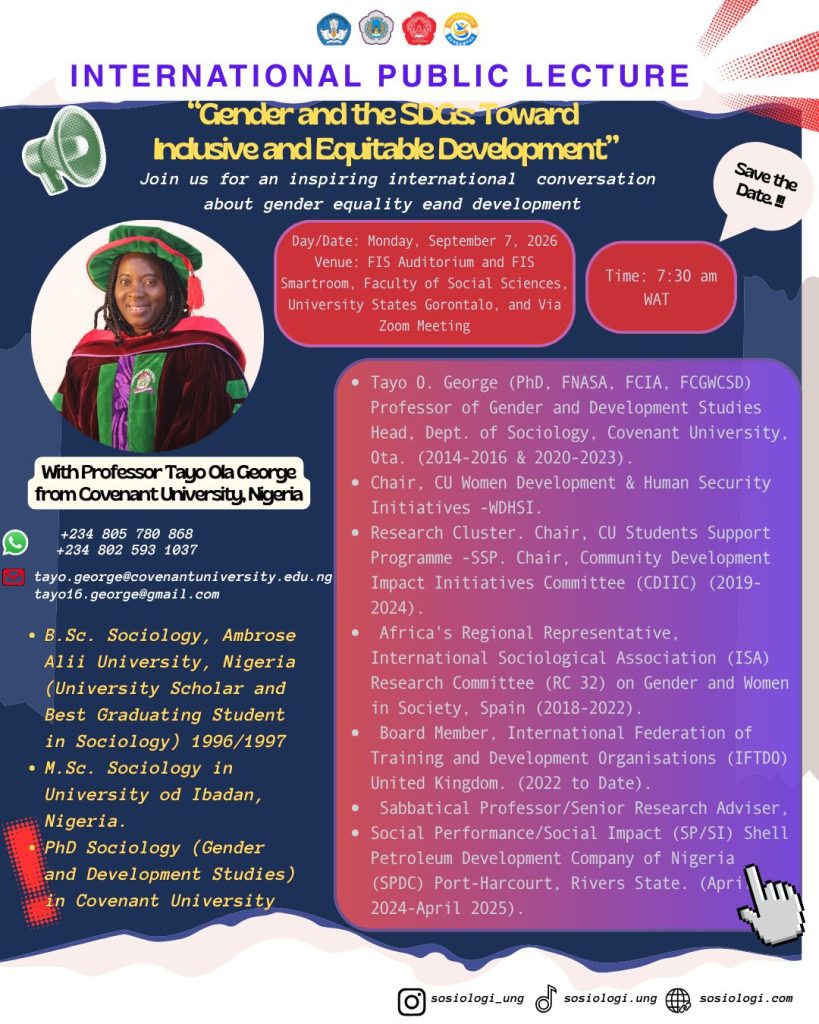
Tayo George, a Professor of Sociology at Covenant University, Ota, Ogun State, made the assertion on Monday, September 7, 2026, in an international public lecture titled “Gender and the SDGs: Towards Inclusive and Equitable Development,” organised by the Department of Sociology, Faculty of Social Sciences, Universitas Negeri Gorontalo, Indonesia.
The lecturer examined the relationship between gender equality and the 2030 Agenda, asking a fundamental development question: “How does gender shape who can access resources, opportunities, participation and development outcomes?” Professor George argued that gender equality cannot be confined to SDG 5 because it influences progress across the entire development agenda.
According to her, inclusive and equitable development becomes possible when structural barriers that restrict access to resources, opportunities and participation are deliberately addressed. She emphasised that gender inequality has consequences that extend beyond individuals to families, communities and national development.
Using the illustrative “Village of Two Rivers” story, the lecturer demonstrated how unequal access to resources can create a chain of disadvantages. Where women were restricted from accessing the more productive water source, the consequences included reduced agricultural output, lower income, less time for education and greater pressure on household wellbeing. Once access became equitable, the community experienced improvements in economic activity, health and cooperation.
“The lesson is that gender and development are inseparable: excluding one gender limits the whole community,” she stated.
Professor George further explained that gender inequality can reinforce poverty, limited education, poor employment opportunities, restricted political participation and inadequate access to essential services. Because these disadvantages can be reproduced across generations, inequality today can ultimately slow broader SDG progress.
The lecturer identified six core commitments under SDG 5: ending discrimination against women and girls; eliminating violence and harmful practices; recognising and sharing unpaid care work; ensuring women's full participation and leadership; guaranteeing universal access to sexual and reproductive health and rights; and securing equal economic rights to property, finance and natural resources.
She also stressed that gender is a cross-cutting thread through the SDGs. From poverty and health to education, decent work, climate action, peace and justice, women and girls can experience distinctive barriers that affect who benefits from development. The implication is that gender considerations must be incorporated into the design, implementation and evaluation of policies across sectors.
However, Professor George noted that progress has been uneven. While significant strides have been made, particularly in education and health, persistent inequalities remain in economic participation, political representation, leadership and access to opportunities. Structural and systemic barriers continue to operate through social, economic, financial and cultural systems.
The lecture also adopted an intersectional perspective, pointing out that gender does not operate in isolation. Factors such as poverty and class, age and disability, ethnicity, location and other social identities can interact with gender to produce different experiences of exclusion. As the presentation cautioned, “Ignoring intersecting disadvantages in universal policies may produce unequal outcomes.”
Among the barriers identified were patriarchal norms, poverty, gender-based violence, unpaid care responsibilities, digital exclusion, limited land rights, political exclusion, financial exclusion, weak institutions, gender stereotypes and inadequate gender-disaggregated data.
The presentation, however, outlined practical pathways towards inclusive development, including legal reform, gender-transformative education, economic inclusion, stronger protection systems, childcare and care infrastructure, digital inclusion, secure property rights, inclusive finance, women's participation in decision-making and better gender data and accountability.
Looking towards 2030, Professor George called for a shared responsibility to close remaining legal and policy gaps, invest in gender data, finance and support women's leadership, and engage men and boys as partners in equality efforts. She stressed that inclusive development requires transformation rather than merely allowing participation.
The presentation's central message was unequivocal: gender equality is not simply a women's issue; it is a development imperative that benefits society as a whole. When opportunities and resources are distributed more equitably, more people are able to contribute to—and benefit from—development.
The lecturer concluded by challenging policymakers, institutions and citizens to ask difficult but necessary questions: Who defines development? Who benefits from it? Who controls resources? Who makes decisions? And whose work remains invisible? These questions, Professor George suggested, are critical to determining whether the SDGs can genuinely be achieved without transforming the gender relations that shape access, power and opportunity.
