

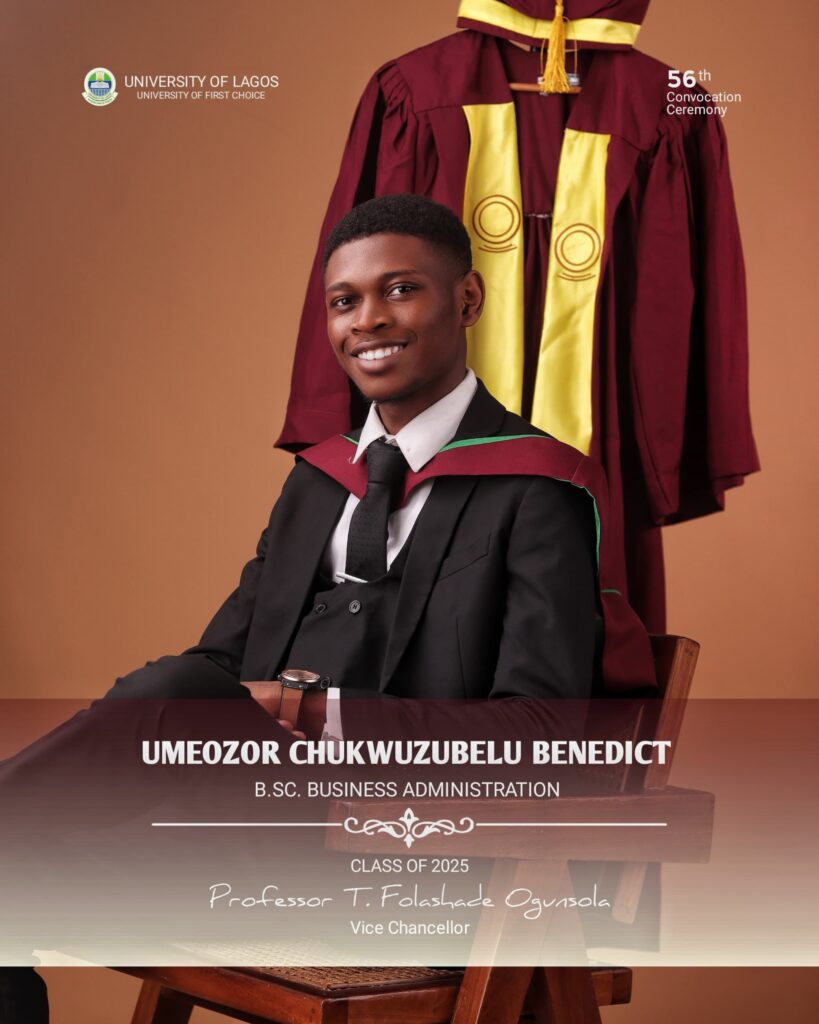
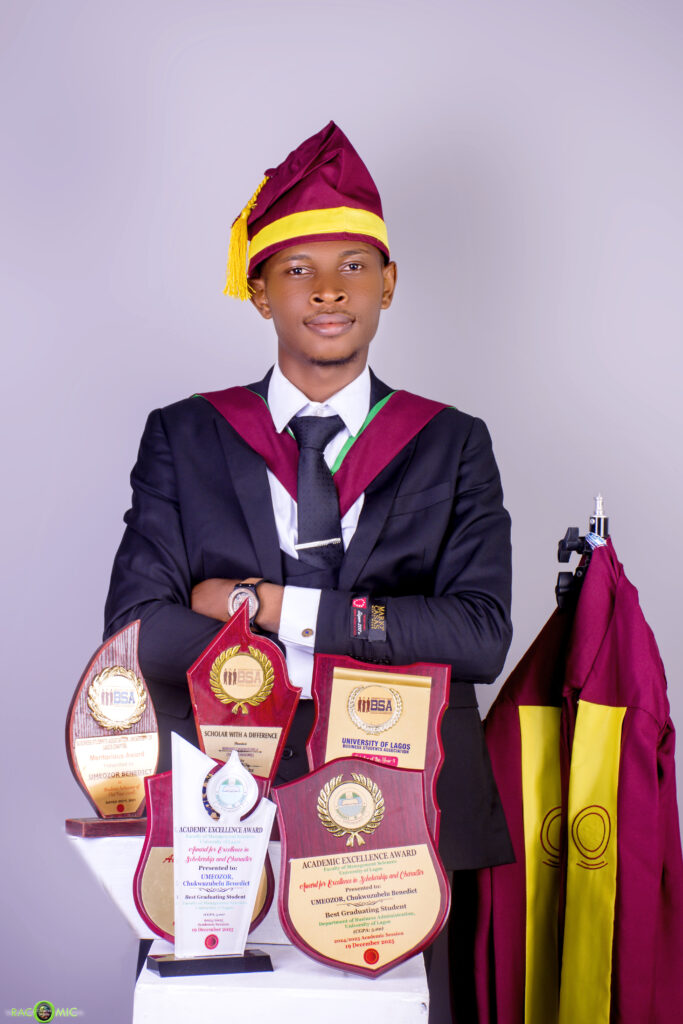
Umeozor Chukwuzubelu Benedict, the overall best graduating student, Class of 2025 of the University of Lagos, shares the story behind his remarkable academic journey in this interview with Ayo Ajayi, Editor at EDUTORIAL.
From setting an early goal of earning a First Class degree to overcoming academic weaknesses through discipline, consistency, and smart study strategies, Benedict, who scored a perfect 5.0 CGPA opens up about the mindset, habits, and lessons that shaped his success and can inspire other students aiming for excellence.
Q: Briefly introduce yourself
A: My name is Umeozor Chukwuzubelu Benedict. I’m the first child in a family of four children.
I had my primary education at Christoba Nursery and Primary School, then attended Morning Star Private School for my junior secondary education, and Ikorodu Senior High School for my senior secondary education.
I went on to study Business Administration at the University of Lagos, where I graduated as the overall best graduating student.
Q: What was your mindset when you entered the university, and did you set a First Class as a clear goal from the start?
A: When I gained admission into the University of Lagos, I came in with a very clear and focused mindset.
From the beginning, I set a personal goal to graduate with a First Class. At that time, I wasn’t necessarily aiming for a 5.0 CGPA, but I was determined to achieve academic excellence.
My biggest motivation was my parents’ sacrifice. They had given so much to ensure I had the opportunity to attend university, and I wanted to make them proud and justify their efforts.
So from my very first day on campus, I stayed intentional about my studies, disciplined with my time, and committed to finishing strong with a First Class degree.
Q: Can you walk us through your daily or weekly study routine while in school?
A: I didn’t follow a completely fixed routine because my schedule in school was quite dynamic.
I was attending classes, working, and also teaching tutorials, so each day looked slightly different.
However, I maintained a core daily structure that kept me consistent.
Most mornings, I left my hostel around 7 a.m. and went to a quiet study space at the Faculty of Arts. I would usually start my day by reading for a few hours while my mind was still fresh.
After that, I switched into work mode, handled my responsibilities, returned to reading later in the day, and also made time to teach tutorials. In the evening, I reviewed anything I hadn’t completed earlier.
Even though my timetable changed often, I kept one non-negotiable rule:
I had to study every single day, no matter how busy I was — even if it was just for one hour.
On lighter days, I could study for several hours, but the key was daily consistency, and that discipline helped me maintain strong academic performance throughout university
Q: Which study techniques or learning strategies worked best for you, especially for difficult courses?
A: My study approach usually depends on the type of course and the format of the exam.
In my earlier years, many of the assessments were multiple-choice, so my strategy was to read broadly, build general understanding, and cover as much of the syllabus as possible.
In the later years, most exams became theory-based, which required deep understanding of lecture materials, course texts, and key concepts.
For more technical or calculation-based topics, I tried to stay ahead of the class by reading textbooks early and using YouTube tutorials to strengthen my understanding before lectures.
For difficult concepts, I focused on simplifying and visualizing the ideas. I sometimes used tools like AI or ChatGPT as a learning partner—I would paste sections of a textbook or lecture note and ask for clearer explanations or real-life scenarios.
This helped me move beyond memorizing words to truly understand the meaning, so even if I didn’t remember the exact textbook phrasing, I could still explain the concept accurately during exams.
Overall, the most effective strategy for me was adapting my method to the course, seeking deeper understanding, and using multiple learning resources.
Q: How did you manage your time between lectures, personal study, social life, and other commitments?
A: I managed my time through clear priorities and daily discipline.
I balanced lectures, study, work, and social life by ensuring I studied every day, used free periods productively, and kept my social activities within healthy limits.
That structure helped me stay consistent and achieve strong academic performance.
Q: What role did attending lectures, tutorials, and practical classes play in your academic success?
A: Attending lectures played an important role in my academic success because they helped me understand the structure of each course, the lecturer’s expectations, and the key areas of focus for assessments.
However, when it came to deeper understanding, I relied more on self-directed learning.
Instead of enrolling in formal tutorial classes, I made extensive use of online learning resources, especially YouTube tutorials, to break down difficult concepts and learn at my own pace.
Q: Were there moments you struggled academically, and how did you overcome those challenges?
A: Yes, I did experience academic challenges, particularly at the beginning of my university journey while adjusting to a new academic system.
One major difficulty for me was calculation-based courses. Even before university, mathematics had been my weakest subject, so it was initially challenging to fully understand quantitative concepts.
However, because I had set a clear goal to finish with a First Class, I knew I had to confront that weakness rather than avoid it.
I deliberately invested extra time in those courses, used YouTube tutorials—especially channels like Organic Chemistry Tutor—and practiced consistently until the concepts became clearer.
Over time, what started as a weakness actually became an area I was more confident in, and that experience taught me the importance of persistence, adaptability, and continuous learning.
Q: How important were past questions, group discussions, or peer learning to your performance?
A: Past questions, peer learning, and group discussions all played important but strategic roles in my academic performance.
For past questions, I didn’t rely on them blindly.
I usually compared the current course outline with that of previous years.
If the structure and lecturer remained largely the same, then past questions became a useful guide for understanding exam patterns and key focus areas.
But if there were significant changes, I reduced my reliance on them and focused more on deep understanding of the course material.
Peer learning and group discussions were also very valuable.
I joined a focused academic group in my class called “The Achievers.”
Being surrounded by disciplined and goal-oriented classmates created a healthy form of positive pressure and motivation, which pushed me to stay consistent and aim higher.
Overall, these strategies complemented my personal study discipline and contributed meaningfully to my success.
Q: Did you have mentors, lecturers, or role models who influenced your academic journey? In what ways?
A: Yes, I was fortunate to have mentors, lecturers, and positive role models who influenced my academic journey in meaningful ways.
Some of my lecturers stood out through their dedication to teaching and their emphasis on discipline, clarity of thought, and academic excellence.
Their commitment motivated me to take my studies more seriously and maintain high standards for myself.
I also had senior colleagues and mentors who guided me practically—sharing study strategies, course insights, and encouragement, especially in the early stages of my university life when I was still adjusting.
Beyond direct mentors, I was inspired by high-performing peers whose consistency and work ethic challenged me to aim higher and remain focused on my First Class goal.
Q: What habits or distractions did you deliberately avoid to stay focused on your goals?
A: I stayed focused by limiting distractions, especially excessive entertainment and social media.
I practiced moderation with leisure activities and made sure my daily priorities remained academic work and personal growth.
Q: What practical advice would you give to current undergraduates who aspire to graduate with a First Class?
A: One key piece of advice I would give to undergraduates who aspire to graduate with a First Class is to be intentional from the very beginning.
Set a clear academic goal early, because that clarity will guide your daily decisions and habits.
Secondly, focus on consistent daily study rather than last-minute preparation.
Even studying for a short time every day builds strong understanding over time.
I would also encourage students to seek understanding, not just memorization—use different learning resources such as textbooks, tutorials, and credible online materials to truly grasp difficult concepts.
Another important factor is discipline and time management.
Limit distractions, manage your time wisely, and surround yourself with focused and motivated peers who will positively influence your mindset.
Finally, believe that it is possible.
Academic excellence is not just about intelligence; it is mostly about consistency, persistence, and the willingness to keep improving.

Congratulations to Unilag best graduating student. The future definitely belongs to him. We pray and hope he sets a pace for others .
Thank God and blessings to all parents for their dedication and care of their children.