
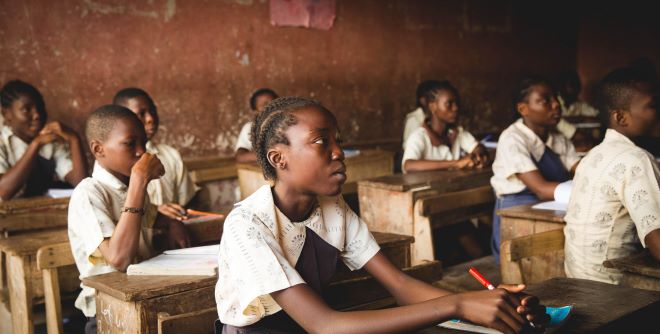
In Africa, progress has been made in a lot of areas over the last few decades. This is something we have regularly covered in our infographics, and this, using figures from UNESCO as quoted by the BBC, reveals another aspect which has seen positive developments of late.
Participation in education is still an issue with room for improvement in sub-Saharan Africa, regardless of gender, but for girls as recently as 2000, the problem was even more acute. At the primary level, just 44 per cent of girls were completing their education 22 years ago. In 2020, that figure had risen to 66 per cent, and had even overtaken the rate for boys (despite healthy gains, too).
Girls remain behind boys at lower and upper secondary levels, but the gaps have been reduced in the past two decades - going from 5 percentage points at the lower secondary level to just two points, and from 6 points at the upper secondary level to 3 in 2020.
Education in Africa: Participation in education is still an issue with room for improvement in sub-Saharan Africa. Image: Statista
The World Economic Forum has been measuring gender gaps since 2006 in the annual Global Gender Gap Report.
The Global Gender Gap Report tracks progress towards closing gender gaps on a national level. To turn these insights into concrete action and national progress, we have developed the Gender Parity Accelerator model for public-private collaboration.
These accelerators have been convened in twelve countries across three regions. Accelerators are established in Argentina, Chile, Colombia, Costa Rica, Dominican Republic, Ecuador, Mexico and Panama in partnership with the Inter-American Development Bank in Latin America and the Caribbean, Egypt and Jordan in the Middle East and North Africa, and Japan and Kazakhstan in Asia.
All Country Accelerators, along with Knowledge Partner countries demonstrating global leadership in closing gender gaps, are part of a wider ecosystem, the Global Learning Network that facilitates the exchange of insights and experiences through the Forum’s platform.
In these countries, CEOs and ministers are working together in a three-year time frame on policies that help to further close the economic gender gaps in their countries. This includes extended parental leave, subsidized childcare and making recruitment, retention and promotion practices more gender-inclusive.
If you are a business in one of the Gender Parity Accelerator countries you can join the local membership base.
If you are a business or government in a country where we currently do not have a Gender Parity Accelerator you can reach out to us to explore opportunities for setting one up.
World Economic Forum
